What the maker puts in writing
- “TRADITIONAL RACLETTE MACHINE: This raclette machine allows you to suspend a portion of cheese wheel and heat it continuously for on-demand serving. With a power of 110V, it is suitable for a table of 6 to 8 guests.”
- “ADJUSTABLE HEATING RAMP: The horizontal heating ramp can be adjusted in height using a rack-and-pinion system with a maneuvering knob to fit the selected cheese size and move closer as the portion decreases.”
- “CONVENIENT: Compact and easy to clean, it takes up little space once stored.”
- “MADE IN FRANCE: Proudly representing French gastronomy, this traditional raclette machine is made in France with our unique craftsmanship.”
- “NOTHING BEATS HANDCRAFTED: Since 1947, Louis Tellier has been manufacturing durable and easy-to-use professional kitchen utensils in France”
- Reference RACL02, sold as the Alpage · Catalog: 460 × 265 × 400 mm (18.1 × 10.4 × 15.7 in)
The one machine here that does the dish the original way
The Hamilton Beach page, alone on this shelf, explains what raclette is: “A centuries old Swiss meal, and the name of the cheese used to make it. Raclette was traditionally prepared over a fire and is now more commonly prepared with the help of specialized electric grills.”
This is the machine that still does it the first way. A half wheel presented cut-face to the heat, melted, and scraped onto the plate — racler is the French for scrape, and that is where the whole dish gets its name.
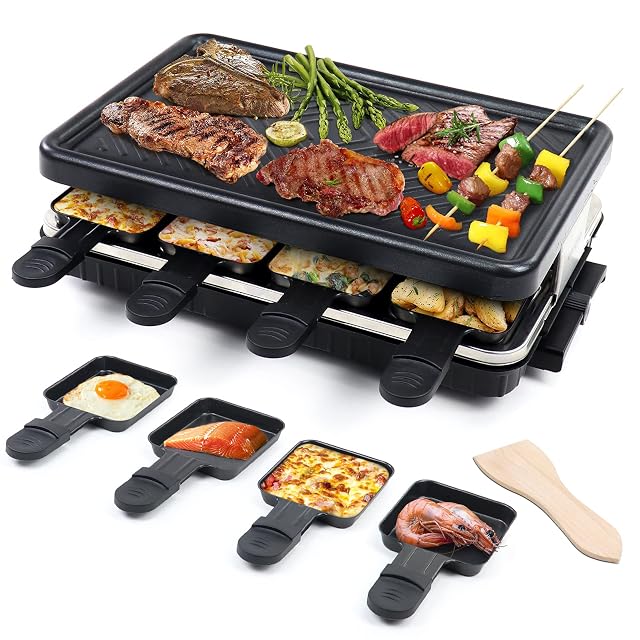
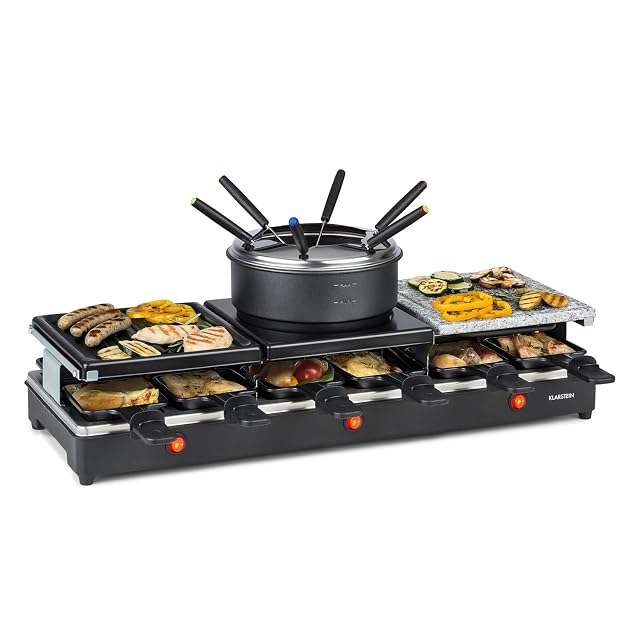
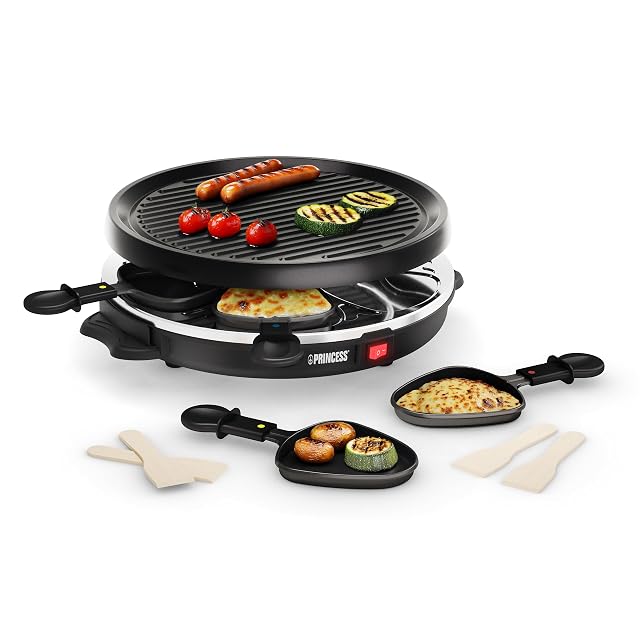
Everything else on this shelf is the modern simplification: instead of one wheel melted by one person, eight people each melt a slice in their own tray. The GIVENEU at $109.99 with 8 non-stick mini pans, the Hamilton Beach at $83.95 with 8 warming trays, the ARLIME at $74.99 with “removable mini grill pans”, the three candle dishes with one or two pans over tealights.
This is the only item here with a moving part, and the only one that is sold for commercial as well as domestic use.
And it is the only one with no grill. No plate, no stone, no griddle, no crepe top. It melts cheese, and that is the entirety of it — where the ARLIME and the GIVENEU also grill meat and hold a fondue, and the Swissmar Stelvio at $179.95 supplies a granite stone and a reversible plate.
So the comparison is not like for like. At $259.99 this is the most expensive item on the shelf and does the least, in the sense of functions — and does the one thing in the way the dish was invented.
A rack and pinion, because the cheese retreats
“adjusted in height using a rack-and-pinion system with a maneuvering knob… and move closer as the portion decreases.”
What happens at the table. You present the cut face to the heat. The surface softens, you scrape the melted layer onto a plate, and the face is now a few millimeters further away. Twenty scrapes over an evening and it has receded by centimeters — and heat falls off with distance, so an element that was melting cheese in two minutes is now barely warming it.
The ramp winds down to close the gap.
A rack and pinion is the correct mechanism for it, and the choice is not cosmetic. It is positive: a toothed rack driven by a gear, so the ramp stays exactly where the knob leaves it. A friction slide would creep — downwards, under its own weight, onto the cheese, next to a hot element.
And the same adjustment covers the other variable, which the bullet names first: cheese size. A half wheel of raclette runs roughly 28 to 35 centimeters across depending on the dairy, so the starting gap is never the same twice.
The ramp is horizontal, which matters for the dish: the cut face is a circle and the element is a bar, so the heat is applied in a band across the face rather than at a point. You scrape a band, lower the ramp, and scrape the next.
What is not published is the travel — how far the ramp moves, top to bottom. That is the figure that says how much of a wheel the machine can see out, and on the one feature this product is built around it is missing.
Continuous heat turns the meal into a service
“heat it continuously for on-demand serving.”
On a tray machine the meal has a rhythm. Eight slices go into eight pans, everybody waits two or three minutes, everybody eats at once. The round is the unit of the meal, and the table eats in lockstep.
Here the face is always molten. Somebody wanting more scrapes, and nobody waits for anybody.
That is why bullet one says commercial use, and it is the honest reason a restaurant buys this shape: service does not have to be synchronized with a cooking cycle.
At a table of 6 to 8 the practical effect is that one person does the scraping for everybody — which is how raclette was eaten before table grills existed, and is either the charm of it or the drawback depending on who you are.
It is also the smallest headcount on the shelf. Every electric grill here claims 8: the Hamilton Beach “up to 8 people” with 200 square inches, the GIVENEU “up to 8 guests”, the ARLIME 8, the Stelvio “8-Person”. This says 6 to 8 — and that is a function of how fast one cut face can be scraped, not of how much cheese it holds.
The cost is that the cheese is heated the whole time, where a tray machine only heats what is in the trays. No wattage is published here, so the running cost cannot be compared with the 1800 W ARLIME or the 1500 W GIVENEU.
Four hundred millimeters tall, and that is the real trade
This is a vertical machine on a shelf of flat ones.
Heights: Swissmar Stelvio 127 mm · GIVENEU 152 mm · Hamilton Beach 181 mm · this 400 mm.
Four hundred millimeters is sixteen inches — the cheese has to be held up where a ramp can be lowered onto it, so the height is structural rather than styling.
At a raclette table everyone must see each other over the appliance for an hour, and this one stands at roughly head height for a seated guest. The Stelvio’s five inches is the opposite choice.
The footprint compensates, and bullet three makes the claim: “Compact… it takes up little space once stored.” 460 × 265 mm is the narrowest machine here — the Stelvio is 419 × 495, the GIVENEU 406 × 406, the Hamilton Beach 394 × 419. Twenty-six centimeters deep is a narrow strip of table, and it stores on its end rather than flat.
Which is the trade in one line: it occupies the air above the table instead of the surface of it.
And no weight is published — the only item on this shelf without one. For reference: Hamilton Beach 3152 g · GIVENEU 5321 g · ARLIME 5443 g · Swissmar Stelvio 7938 g · the candle dishes 300, 422 and 710 g. On a tall machine carrying a heavy wheel of cheese on a cantilever, the base mass is what keeps it upright, and it is absent.
Made in France since 1947, which is the argument for the price
“made in France with our unique craftsmanship” · “Since 1947, Louis Tellier has been manufacturing durable and easy-to-use professional kitchen utensils in France”
This is the only item on the shelf with a country of manufacture. Not the Stelvio at $179.95, not the GIVENEU, not the ARLIME, not the Hamilton Beach, none of the Swissmar porcelain.
And the only one with a founding date. Seventy-nine years of making professional kitchen tools is the substance behind “commercial and home use”, and a professional tool is a different object from a party appliance: serviceable, bolted rather than clipped, built around one mechanism that is expected to work for years.
The rack and pinion is consistent with that. It is the expensive way to make an adjustment, chosen because it does not drift.
But durability is asserted and not warranted. The word “durable” appears and no term does — and the only published warranty on this shelf is the Artesà’s 5 year guarantee, on a $24.95 candle dish. Nine of ten items here, this one included, publish none.
“Easy to clean” is the other asserted claim, in bullet three, with nothing behind it. No part is named as removable, and nothing is said to be dishwasher safe — where the GIVENEU names its bowl, forks, pans and plate individually and the Hamilton Beach says plate, trays and accessories are all dishwasher safe. Melted cheese that has run down a heating ramp and set is the worst washing-up this shelf can produce, and the claim is two words long.
The one habit worth adding: wipe it while it is still warm. Set raclette cools to a rubber.
What you have to buy before it works, and the page does not say
A half wheel of raclette cheese.
A full wheel runs around 5 to 7 kilograms, so a half wheel is several kilograms — a substantial, perishable purchase, and not stocked everywhere.
No capacity is published. Not a diameter, not a weight range, not a minimum portion the mount will still grip once the wheel is half gone. On a machine built around one specific format, the format is missing — and the bullet concedes the variation itself by making the ramp fit “the selected cheese size”.
Everything else on this shelf eats slices. A supermarket pack of sliced raclette feeds the GIVENEU’s 8 mini pans, the Hamilton Beach’s 8 trays or the $21.95 Nordic’s single dish over 3 tealights.
And the cheese is worth naming, because it is the one variable no machine controls: raclette is a semi-hard Swiss cow’s-milk cheese bred to melt without separating. Substituting a cheddar gives a greasy pool rather than a scrape, on any machine here.
What is not published
No wattage. “110V” is a voltage, not a power. The ARLIME publishes 1800 W — 15 amperes, a full American circuit — and the GIVENEU 1500 W. On a machine that heats continuously, the power is the running cost, and it is absent.
No weight, as above, and uniquely on this shelf.
No cheese capacity, as above.
No ramp travel, on the one feature the product exists for.
No temperature control. Bullet two adjusts height, which is how this machine controls heat — closer is hotter. There is no thermostat mentioned, where the GIVENEU publishes “dual independent thermostats” and the ARLIME “independent controls”. Melting cheese wants 50 to 60 °C and splits above it, and here the only dial is the knob that moves the bar.
No timer and no auto shutoff, which nothing on this shelf has. Only the Hamilton Beach has an indicator light, and its page says why: “a reminder to turn it off when you’re finished cooking.” On a machine with no timer, unplug it rather than switching it off — and on one that heats continuously, that matters more here than anywhere else on the shelf.
No cord length. The ARLIME’s 2.5 ft is the only one published on this shelf, and thirty inches is the figure that decides whether a table appliance reaches a table. “US Cord” in the name confirms the plug and not the reach.
No cleaning detail, as above.
No warranty, as above.
Availability
Read on the day this page was built: $260 at the American Amazon shop.
Read from Keepa on the day this page was last revised; stock and price both move without notice.
Prices quoted in this text were read on 2026-10-05. The live price is at the top of the page.