What the maker puts in writing
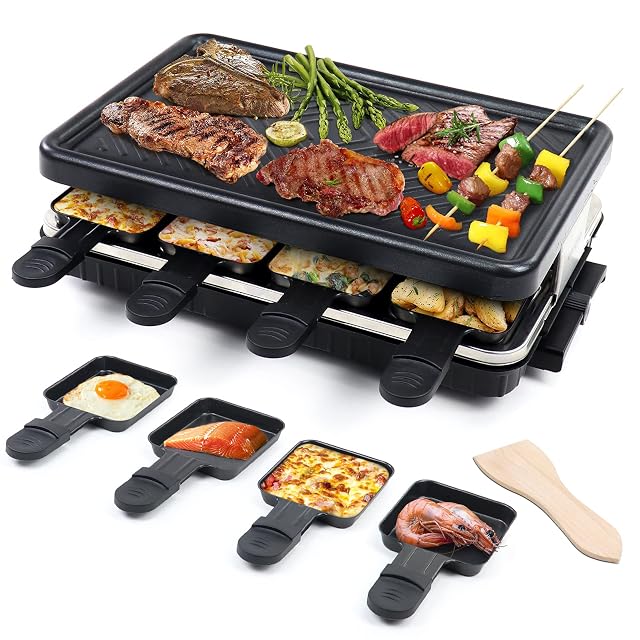
- “SERVES UP TO 8 PEOPLE: …includes a large 200 square inch nonstick, dual-texture grill/griddle surface and 8 heat-resistant warming trays for individual servings.”
- “GRILL A VARIETY OF FOODS WITH VARIABLE HEAT CONTROLS: …perfect for searing meats, shrimp, and vegetables at a much higher heat while cheeses and sauces warm in the individual raclette warming trays below.”
- “EASY CLEANUP: The nonstick grill plate, raclette warming trays and accessories are all dishwasher safe.”
- “CUSTOMIZE EACH SERVING WITH 8 WARMING TRAYS: …each person can easily customize their dish… Table temperature: Perfect for keeping cheese warm on a low temperature or searing shrimp on a much higher heat”
- “INDICATOR LIGHT ILLUMINATES WHEN GRILL IS ON: The light on the front of the grill illuminates when it’s on as a reminder to turn it off when you’re finished cooking.”
- “WHAT IS RACLETTE: A centuries old Swiss meal, and the name of the cheese used to make it. Raclette was traditionally prepared over a fire and is now more commonly prepared with the help of specialized electric grills.”
- Reference 31612MN-MX · Catalog: 3152 g (111.2 oz), 394 × 419 × 181 mm (15.5 × 16.5 × 7.13 in)
Nothing else here publishes one.
The ARLIME at $74.99 says “a roomy grilling area”. The GIVENEU at $109.99 says “a non-stick circular grill plate on the outer ring”. The Swissmar Stelvio at $179.95 publishes two bullets and neither is a specification.
So this is the one machine on the shelf you can size.
200 square inches is about 1,290 square centimeters — roughly a 14-inch square, or a little over an A3 sheet. For eight people that is 25 square inches each, which is enough for two or three pieces of meat at a time and not enough for everybody at once. Which is correct for the format: raclette is eaten in rounds over an hour, not plated all together.
And the plate is dual-texture, which is the shelf’s universal idea in its own form: “a large 200 square inch nonstick, dual-texture grill/griddle surface”.
All four electric machines solve it differently:
this — one plate, two textures across its surface
ARLIME — a double-sided plate, “two cooking styles in one”
Swissmar Stelvio — a granite stone / crepe top, reversible
GIVENEU — two separate plates: a non-stick grill plate and a granite grill stone
Why texture matters: a ribbed surface gives you grill marks and lets fat drain away from the meat; a smooth griddle gives you full contact, which is what eggs, onions, prawns and anything small need so they do not fall through. A raclette table wants both, because the point is that eight people cook eight different things.
Height instead of thermostats, which is the elegant answer
“searing meats, shrimp, and vegetables at a much higher heat while cheeses and sauces warm in the individual raclette warming trays below.”
The problem every machine on this shelf faces: melting cheese wants 50 to 60 °C, and a tray or pot held hotter splits — the fat separates from the protein. Searing meat wants 200 °C or more, because browning does not begin below about 140 °C.
A hundred and forty degrees apart, on one appliance.
Two machines here solve it with electronics. The ARLIME publishes “independent controls for the grill panel and fondue pot”; the GIVENEU publishes “dual independent thermostats… without one zone affecting the other”.
This solves it with distance. The element heats the plate on top; the 8 trays sit underneath, further from the heat, so they run cooler for nothing.
Heat falls off with distance. A tray a few inches below a grill plate is at a fraction of its temperature — no second circuit, no second dial, nothing to go wrong.
What you give up is control of the ratio. With two thermostats you can have a gentle grill and a hot pot, or the reverse. Here the trays are always cooler than the plate by whatever the geometry gives.
Which is the right way round for raclette and it is fixed. Bullet four states the span the single control covers: “keeping cheese warm on a low temperature or searing shrimp on a much higher heat.”
No numbers are published — no range, no settings count, no watts. “Variable heat controls” is the whole of it, which on the one machine here that publishes a grill area is an odd place to stop.
No fondue pot, which is a choice rather than an oversight
Nothing on this page mentions a pot, a caquelon or a bowl.
The two dishes are different things. Fondue is a shared pot of melted cheese that guests dip into with long forks. Raclette is cheese melted in an individual tray and scraped onto your own plate — the word is the French for scrape.
The shelf divides:
Both — ARLIME $74.99 (a 304 stainless steel pot), GIVENEU $109.99 (a 600 ml stainless bowl), Swissmar Tandem $34.95 (a pot and 2 fondue forks)
Raclette only — this, the Swissmar Stelvio $179.95, the Swissmar Nordic $21.95, the Artesà $24.95, and the Louis Tellier $259.99, which does it the oldest way of all with a suspended half wheel
Tableware — the two Swissmar porcelain items
And there are two good reasons to leave the pot out.
A fondue pot takes the hottest real estate. The GIVENEU puts its bowl in the center and gives the grill the outer ring — so a machine without a pot has more grill, which is exactly why 200 square inches is the largest published area here.
And a fondue pot is the hardest part to clean, which every page on this shelf concedes by making dishwasher-safety a selling point.
This page’s cleaning claim is complete: “The nonstick grill plate, raclette warming trays and accessories are all dishwasher safe.” Compare the Swissmar Tandem at $34.95, which is hand wash only — and set cheese cools to a rubber, which is the worst washing-up on this shelf.
One habit no page here gives: load it while the cheese is still warm.
It is the only page that explains the dish
“WHAT IS RACLETTE: A centuries old Swiss meal, and the name of the cheese used to make it. Raclette was traditionally prepared over a fire and is now more commonly prepared with the help of specialized electric grills.”
A whole bullet spent on the dish rather than the product, and nothing else on this shelf does it.
Two facts in it are worth having. Raclette is the cheese as well as the meal — a semi-hard Swiss cow’s-milk cheese bred to melt without separating, which is why substituting cheddar gives a greasy result. And it was made over a fire, with a half wheel set beside the flames and the melted face scraped off.
Which puts the Louis Tellier at $259.99 in context, because that is the machine on this shelf that still does it that way: “suspend a portion of cheese wheel and heat it continuously”, with a heating ramp that moves closer as the portion decreases.
And it makes the format of everything else clear. The eight-tray electric grill is a modern simplification: instead of one wheel melted by one person, eight people each melt a slice in their own tray. The GIVENEU does the same with 8 non-stick mini pans; the ARLIME with “removable mini grill pans”.
The description adds the social argument, which is the honest reason to buy any of these: “there’s minimal meal prep and no running back and forth to the kitchen.” A raclette grill is a way of cooking at the table, so the host sits down — and that is the whole appeal.
The indicator light, and why it matters more here than it looks
“The light on the front of the grill illuminates when it’s on as a reminder to turn it off when you’re finished cooking.”
No electric machine on this shelf publishes a timer. Not this one, not the ARLIME, not the GIVENEU, not the Swissmar Stelvio, not the Louis Tellier. There is no auto shutoff anywhere here.
So a raclette grill stays on until somebody turns it off — and a raclette dinner ends with eight people pushing chairs back, a table covered in plates, and an appliance in the middle still at searing temperature.
A light on the front is the cheapest possible answer, which is why the bullet frames it as a reminder rather than a feature.
For comparison on this site: the mini-oven shelf has eight machines, six of which publish a timer with auto shutoff, and the $24.99 Dash there pairs an indicator light with its shutoff for the same reason.
A raclette grill has no cycle to end, so the light does the whole job alone.
One habit the page does not give: unplug it rather than switching it off. The light tells you the switch position, not the plug.
And at 3152 grams this is the lightest electric machine on the shelf — GIVENEU 5321 g · ARLIME 5443 g · Swissmar Stelvio 7938 g — which matters because a raclette grill is used a few times a year and stored the rest of it. The candle machines are 300, 422 and 710 grams, which is the argument for that end.
What is not published
No wattage. The ARLIME publishes 1800 W — which at 120 volts is 15 amperes, a full domestic circuit — and the GIVENEU 1500 W. This, the Stelvio and the Louis Tellier publish none, the last giving only “110V”. On the machine with the largest published grill area, the power driving it is the obvious companion figure.
No cord length. The ARLIME is the only item on this shelf to publish one — a 2.5 ft cord, which is thirty inches — and that is the figure that decides whether a table grill reaches the middle of a table. No other electric machine here states it, so the others may be no better and you cannot tell.
No temperature range or settings count, as above.
No tray dimensions, where 8 trays is stated and their size is what decides how much cheese each holds.
No accessory list. “accessories” appears in the cleaning bullet and nothing names them — where the GIVENEU itemizes its kit completely (a 600 ml bowl, a splash-guard collar, a grill plate, a granite grill stone, 8 forks, 8 mini pans, 8 wooden spatulas) and the ARLIME publishes a count of 26 with color-coded fork handles.
No spatulas named, which matters because raclette means scrape and a metal tool on a non-stick tray cuts the coating. The GIVENEU supplies 8 wooden spatulas; all three candle machines here supply one each.
No first-use instruction, which two pages on this shelf publish identically: run the grill empty for 10 minutes to burn off the factory coating, with a mild odor and slight smoke expected once. That applies to any new non-stick plate, including this one.
No warranty, which nine of ten items here omit. The exception is the Artesà at $24.95, with a 5 year guarantee.
Availability
Read on the day this page was built: $84 at the American Amazon shop.
Read from Keepa on the day this page was last revised; stock and price both move without notice.
Prices quoted in this text were read on 2026-10-05. The live price is at the top of the page.