Pressure, and the eleven programs you will not use · review
Midea CS6037W review
The highest published pressure of this family at 80 kPa, in a 6-liter body with a stainless steel inner pot. Midea lists nine functions in the name and fourteen in the specification, covering yoghurt, rice, slow cooking, sous-vide, steaming and pasta, with keep-warm on top.
The net of it The specification-led choice. 80 kPa is the highest published pressure here and the stainless inner pot is the longest-lived component in the family — coatings are what fail on these machines, and this one does not have any. Midea also publishes a real safety instruction rather than a slogan: do not turn the release valve after cooking liquids. Against that, no wattage is published, and the function count differs between the name and the text.
80 kPa
The highest published working pressure of the four multi-cookers here.
Aigostar publishes 60 kPa; the Cosori and the Instant Pot publish nothing.
Pressure is what changes cooking times against an ordinary pan, and it is
the one figure in this family that is a property of the machine rather
than a label on a button.
The inner pot
Stainless steel. On these machines the inner pot is the wear part —
it is scraped, stacked and washed daily — and a coating is what goes
first. A stainless pot outlives every coated one, and it is the reason to
put this model against the Cosori’s ceramic and the Aigostar’s non-stick.
Nine, or fourteen
The product name says 9-in-1; the specification lists 14
functions. Both are Midea’s, and both appear above. The stated modes are
worth reading rather than counting: yoghurt, rice, slow cook,
sous-vide, steam, pasta, with keep-warm.
Sous-vide on a pressure cooker is a low, held temperature rather than a
circulating bath — this site’s sous-vide hub covers the dedicated tools,
and the difference between the two is real.
A published caution
Midea prints an instruction most listings leave out: after cooking liquid
foods such as porridge or soup, do not turn the outlet valve or press
the steam release. We report it as the manufacturer’s own; the manual
with your unit governs the release method for each food.
What is not published
No wattage, and no count of safety systems — where Aigostar names its
valve, its lid lock and its overheat protection.
The plus side, and the minus
Strengths
80 kPa — the highest published working pressure of the four here
Stainless steel inner pot rather than a coating that wears
Sous-vide among the stated functions, alongside yoghurt and slow cooking
The same reference across five markets, with an offer on Amazon UK
Compromises
The function count is 9 in the name and 14 in the specification
No wattage published
No offer on Amazon Italy at the time of writing
Midea publishes safety instructions but no count of safety systems
Do not turn the release valve after cooking liquids such as porridge or soup
Amazon reference
B08KDRYDLL (identical on 5 markets)
EAN
6936718328942
What readers want to know
Why does a stainless inner pot matter?
Because the inner pot is the part that wears out on every electric pressure cooker, and a coating wears faster than steel. Of the four here, Midea and Instant Pot state stainless, Aigostar states non-stick and Cosori ceramic non-stick.
What is the warning about the release valve?
Midea publishes it directly: after cooking liquid foods such as porridge or soup, do not turn the outlet valve or press the steam release. That is the manufacturer’s own instruction, and the manual shipped with your unit is the authority on the release method for each type of food.
Our score
7.8/ 10
The specification-led choice. 80 kPa is the highest published pressure here and the stainless inner pot is the longest-lived component in the family — coatings are what fail on these machines, and this one does not have any. Midea also publishes a real safety instruction rather than a slogan: do not turn the release valve after cooking liquids. Against that, no wattage is published, and the function count differs between the name and the text.
What this one costs among kitchen appliances
A reference exists on these Amazon stores: France, Germany, Italy, Spain, United Kingdom. Listed is not the same as in stock — availability changes daily.
Details checked on August 23, 2026.
The buyer this one serves, among kitchen appliances
Anyone who would rather not own an inner pot with a coating on it.
Specifications: the manufacturer sheet for kitchen appliances and the matching Amazon product page. Prices and availability: Keepa. Every figure on this page names its source.
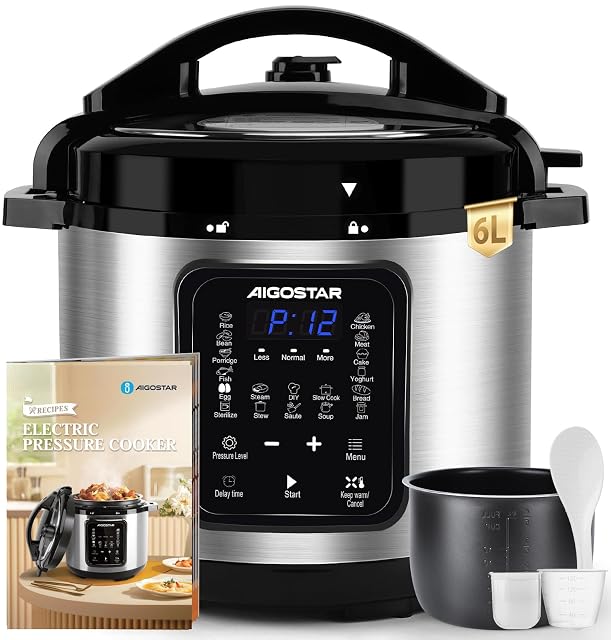
A 6-liter electric pressure cooker that publishes the two figures this family is decided by: 1,000 W and up to 60 kPa, across three selectable pressure levels. Eighteen programs, a non-stick inner pot, more than ten stated safety systems, and — unusually — a printed multilingual recipe book rather than a PDF.
Best for: A first electric pressure cooker, with three pressure levels and something printed to read.
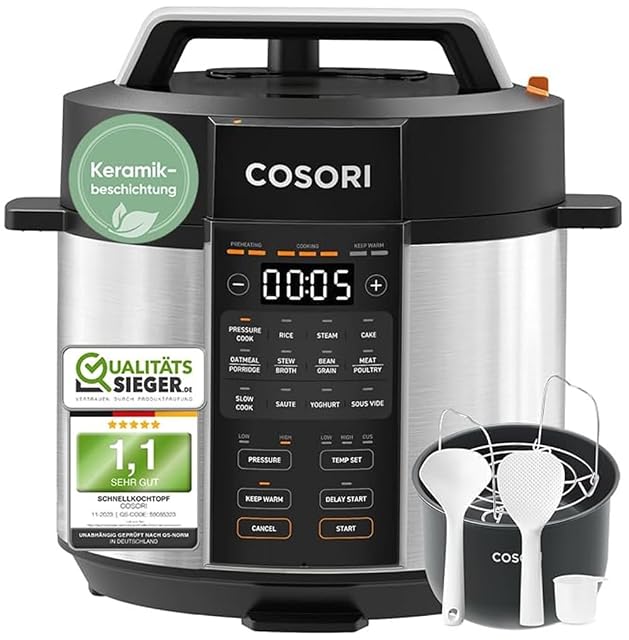
A 5.7-liter nine-in-one with a ceramic non-stick inner bowl, fourteen smart programs on an LED display, and twelve stated safety features — including a shut-off and release button placed away from the steam outlet. Cosori states cooking up to 70% faster than conventional methods.
Best for: A cook who cares more about the interlocks and the cleaning than about kPa.
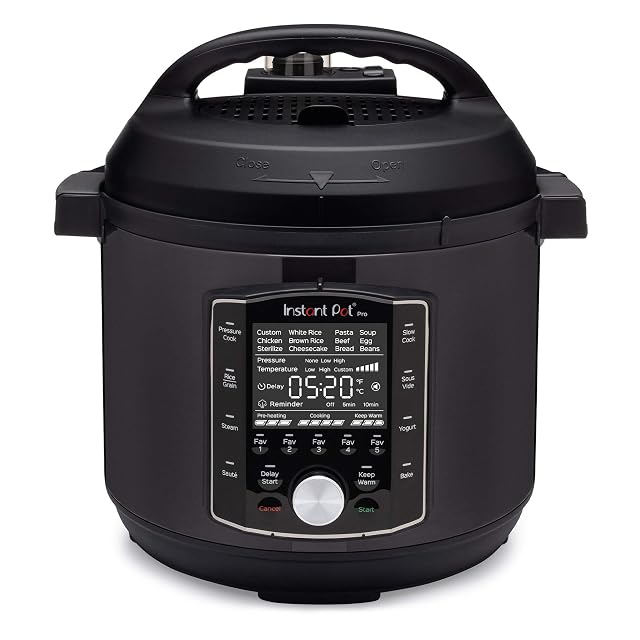
The Instant Pot Pro: 1,200 W in a 5.7-liter stainless body covering ten roles — pressure cooker, slow cooker, rice cooker, steamer, sauté pan, steriliser, yoghurt maker and sous-vide among them. Instant Pot states 20% faster preheating and up to 70% less cooking time, and that settings can be saved to one touch.
Best for: A cook who repeats recipes and wants the machine to remember them.