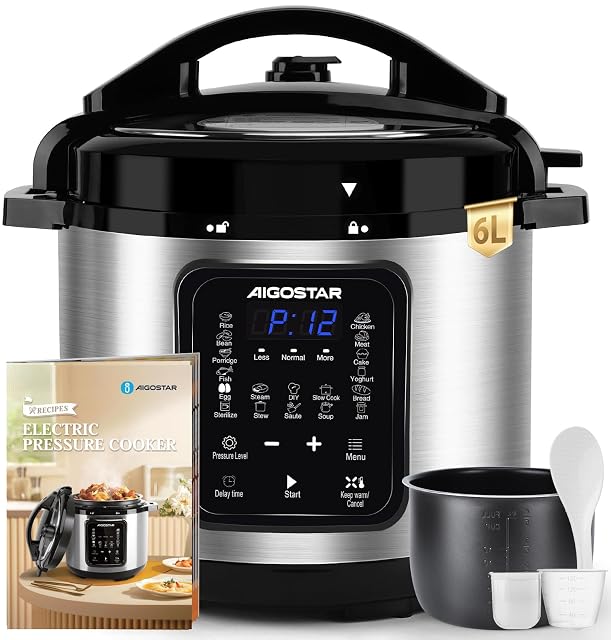
What the maker puts in writing
- “16-in-1 Customizable Functions: This versatile multicooker combines a pressure cooker, slow cooker, rice cooker, and steamer in one appliance. With 12 preset programs…”
- “Custom Cooking Programs: …It automatically adjusts time and pressure for each preset, while offering manual customization and a convenient 24-hour delay start function”
- “Built-In Safety Protections: …a multi-level safety system, including overheat and dry-boil protection. A clear lid reminder on the display ensures the unit is properly closed before cooking begins”
- “Perfect for Family Portions: With its 6-quart pot… ideal for households of 3 to 5… from whole chicken and hearty soups to homemade yogur”
- “Durable and Simple to Clean: …a high-quality ceramic inner pot that resists scratches. The lid and sealing ring are dishwasher safe, and the outer body cleans easily with a quick wipe”
- From the name: “6QT”, “Recipe Book”
- Reference M-60F6 · Catalog: 5398 g (190.4 oz)
It pressurizes, which at least eight of the eighteen machines here do not
This is the question the shelf divides on, and it is the only one that changes what the appliance can do.
The six pressure cookers: this at $49.91 (6 qt) · the COMFEE’ at $68.99 (6 qt) · the Cosori at $80.99 (6 qt) · the Instant Pot Rio Mini at $89.99 (4 qt) · and the three Ninja HyperHeat machines at $139.99, $139.99 and $169.99 (6.5 qt).
The eight that do not: the three BELLA machines at $79.99, $79.99 and $93.95 · the Presto at $88.76 (10 qt) · the PowerXL at $95.99 (7.5 qt) · the Ninja PossibleCooker PLUS at $129.99 (8.5 qt).
Why it matters. Pressure is the only mechanism on this shelf that cooks faster than a pan on a hob. Raising the pressure raises the boiling point of water — so the food cooks at above 100 °C instead of at it, and a beef shin that takes three hours in a pot takes under one.
Everything else on this shelf is a well-made pot with a heating element in the base. Which is a perfectly good thing to own — the Presto at $88.76 holds 10 quarts and deep fries, the PowerXL at $95.99 stirs itself, the Ninja machines go in the oven to 500 °F — and none of them is faster than a stove.
And that is what makes the speed claims on this shelf worth reading carefully. The Instant Pot at $89.99 says “up to 70% faster compared to slow cooking methods”. Ninja’s HyperHeat says “up to 2X FASTER *Vs traditional slow cooking”. Comparing a pressure cooker with a slow cooker is comparing it with the slowest method there is.
At $49.91 this is the cheapest machine on the shelf by nineteen dollars, and the cheapest pressure cooker by the same margin.
Sixteen in the title, four appliances and twelve presets in the bullets
The title says “16-in-1”. Bullet one names four appliances — pressure cooker, slow cooker, rice cooker, steamer — and “12 preset programs”.
Which is not unusual on this shelf. It is close to universal.
COMFEE’, $68.99 — a title saying “12-in-1”, a bullet headed “9 IN 1” that names nine, and a bullet headed “12PRESETS” whose text says “14 programmable preset functions”. Three incompatible numbers on one page.
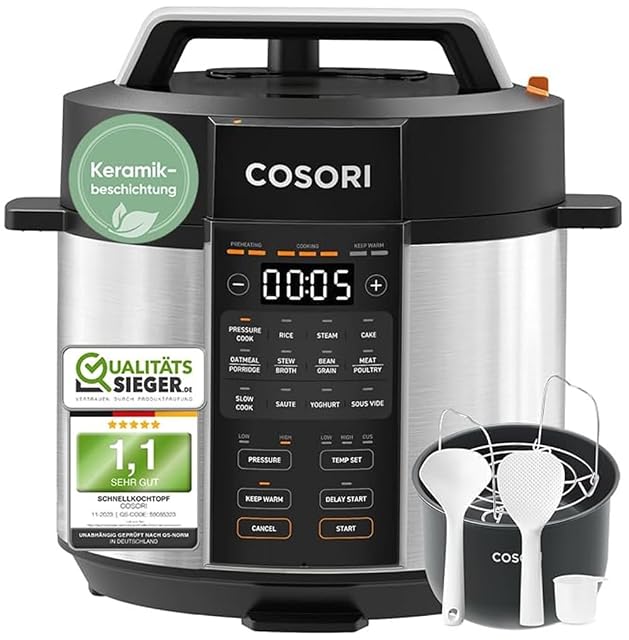
Cosori, $80.99 — “9-in-1”, and a bullet listing thirteen functions
BELLA, $79.99 — “10-in-1”, “Replace Ten Bulky Kitchen Appliances”, four of them named, and “eight versatile presets”
Ninja PossibleCooker PLUS, $129.99 — “6-in-1”, six functions named twice, and “REPLACES 12 COOKING TOOLS & APPLIANCES”
Ninja PRO Plus, $139.99 — “9-in-1”, nine named, “REPLACES 16”
Ninja HyperHeat, $139.99 — “9-in-1”, and a bullet naming seven plus “and more”
Presto, $88.76 — no count at all, just a list of what it does
Two pages on this shelf are self-consistent. The Instant Pot Rio Mini at $89.99 says “7-in-1” and names exactly seven. The PowerXL at $95.99 publishes no “in-1” count and names nine presets exactly.
How to read any of it: count the presets, not the marketing number. A preset is a button on the machine. An “in-1” is a claim about appliances you might otherwise own, and it is counted differently by every maker here.
The four appliances named on this page are the four that matter on a pressure cooker — pressure, slow cook, rice, steam — and the twelve presets are the real figure.
And bullet two adds the thing that matters more than either. “It automatically adjusts time and pressure for each preset, while offering manual customization.”
A preset is somebody else’s guess at your recipe. Manual time and pressure is what lets you follow your own, and not every machine on this shelf says it has it.
Dry-boil protection and a lid reminder, neither published anywhere else here
“a multi-level safety system, including overheat and dry-boil protection. A clear lid reminder on the display ensures the unit is properly closed before cooking begins.”
Both are unique on this shelf, and both address real failures.
Dry-boil. A pressure cooker needs liquid. Pressure comes from water turning to steam — no water, no pressure, and the element heats a dry ceramic pot with nothing to carry the heat away.
A dry pot reaches element temperature rather than boiling point, which is how a coating is destroyed and a seal is cooked. And it is the easiest mistake to make on a pressure cooker, because you load it, shut the lid and cannot see in.
The lid reminder. A pressure cooker that starts heating with the lid not fully seated builds no pressure and vents steam at the rim — and a message on the display is the cheapest way to catch it.
How the rest of the shelf covers safety.
Cosori, $80.99 — “12 Safety Features”, and three named: a “double-layer anti-scalding lid”, “overheat protection”, and the most specific detail on this shelf — “The Seal/Vent button away from the steam release valve, and the 30° backward-angled steam release design”
COMFEE’, $68.99 — “10 safety features”, including “overheat protection, auto pressure release and lid-safety lock system”
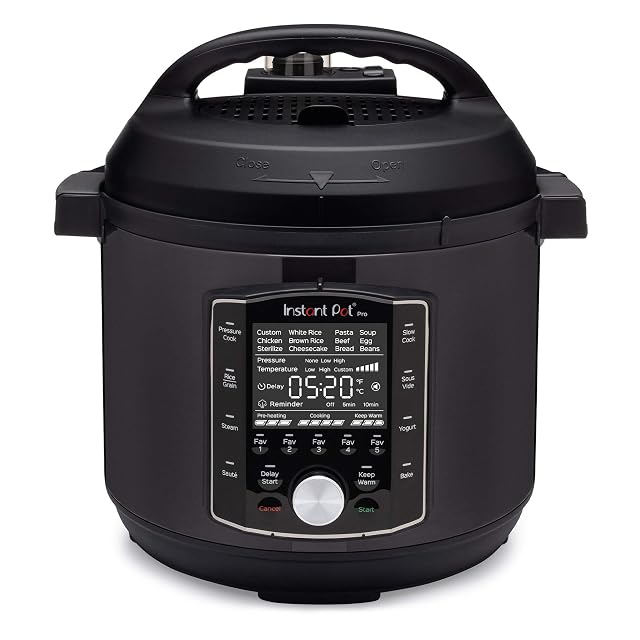
Instant Pot, $89.99 — “over 10 proven safety features, including overheat protection and an auto-sealing locking lid”
The eight non-pressure machines — none, which is reasonable: without pressure there is no vessel to fail
The Cosori’s venting detail is worth borrowing as a habit on any pressure cooker here. The scald risk is reaching across a steam jet to turn a valve — and the only published answer to it on this shelf is to put the button somewhere else and angle the jet away.
Six quarts, for three to five people
“With its 6-quart pot, this multifunctional pressure cooker is ideal for households of 3 to 5. It efficiently prepares substantial meals—from whole chicken and hearty soups to homemade yogur[t]”
Six quarts is the commonest capacity on this shelf — this, the COMFEE’ at $68.99 and the Cosori at $80.99.
The full range:
4 qt — the Instant Pot Rio Mini at $89.99: “perfect for up to 4 servings, ideal for students, singles, and small families”, with “the same cooking surface as an 8-inch pan”
6 qt — this, the COMFEE’, the Cosori
6.5 qt — the three Ninja HyperHeat machines: “up to a 4-lb chicken or 5-lb roast, feeding 8–10 people”, on a “9.5” diameter surface
7 or 8.5 qt — the three BELLA machines, which contradict themselves: the title says “7qt” and bullet two says “Generous 8.5-quart cast aluminum pot”
7.5 qt — the PowerXL at $95.99: “two whole chickens or 6LBS of pork”
8.5 qt — the Ninja PossibleCooker PLUS at $129.99 (“chili for up to 20 people”, “9 lbs of spaghetti and meatballs”, “pulled pork for 30 sliders”) and the Ninja PRO Plus at $139.99 (the same, at “10 lbs of spaghetti”)
10 qt — the Presto at $88.76, the largest here
And the useful comparison is not quarts but what fits. This page says “whole chicken”. The 6.5 qt Ninja says “4-lb chicken or 5-lb roast”. The 7.5 qt PowerXL says “two whole chickens”. The 8.5 qt BELLA says “a full five-pound chicken with room to spare”.
So six quarts is one chicken, and the jump to two chickens is at seven and a half.
On a pressure cooker there is a second limit nobody on this shelf states: the fill line. A pressure cooker is never filled to the brim — typically no more than two thirds for solids and half for anything that foams, such as beans, rice, oats or pasta. So a “6-quart” pressure cooker is a four-quart cooking volume for most things and a three-quart one for grains.
Which makes the 4 qt Instant Pot’s honesty about “4 servings” the fairer statement on this shelf, and it is the only machine here sold explicitly for one or two people.
A ceramic pot, with no chemistry named
“a high-quality ceramic inner pot that resists scratches”
Scratch resistance is the right claim for ceramic — a sol-gel ceramic coating is harder than a sprayed fluoropolymer — and the page stops there.
Four items on this shelf publish a chemistry claim, and they are not equivalent.
BELLA, $79.99 — the only footnote on this shelf: “EverGood Non-Toxic* Ceramic Nonstick Coating”, with the asterisk defined as “ceramic coating materials made without PFAS, PTFE, PFOA, lead or cadmium”
Presto, $88.76 — “PFAS-free ceramic nonstick finish, inside and out”, the only “inside and out” here
Ninja PRO Plus, $139.99 — “MADE 100% PFAS FREE: Inner pot features a nonstick ceramic cooking surface designed with no PFAS, PTFEs, or PFOAs”
Ninja HyperHeat, $139.99 and $169.99 — “PFAS-FREE NONSTICK… made 100% PFAS-free”
And one makes the weaker version of the same claim. The Ninja PossibleCooker PLUS at $129.99: “Free of PFOA, cadmium, and lead” — which says nothing about PFAS or PTFE at all.
Why the difference matters. PFAS is the whole family of per- and polyfluoroalkyl substances. PTFE — sold as Teflon — is one member of it. PFOA is another, historically a processing aid in making PTFE and phased out of that use. So “PFOA-free” is a much smaller statement than “PFAS-free”, and the two appear on the same shelf from the same maker.
Three pages here say “ceramic” with no chemistry: this, the Cosori at $80.99 and the PowerXL at $95.99. One says only “Nonstick Pot”: the COMFEE’ at $68.99.
And one sidesteps the question entirely. The Instant Pot Rio Mini at $89.99 has a “stainless steel pot” — the only stainless inner pot on this shelf.
What ceramic buys and gives up. Release without a fluoropolymer, and more scratch resistance than a sprayed coating. What it gives up is longevity — a ceramic coating loses slipperiness with use, where stainless does not, and a stainless pot can be scrubbed and a ceramic one cannot.
And the cleaning statement here is narrower than it first reads. “The lid and sealing ring are dishwasher safe, and the outer body cleans easily with a quick wipe.”
The pot is not named. Compare the shelf: the Instant Pot says “Dishwasher-safe lid and cooking stainless steel pot”; the Ninja PRO Plus says “Inner pot, lid, and spoon are all dishwasher safe”; the PowerXL says “Pot, Lid, and Paddle go straight into the dishwasher”; the Cosori says “dishwasher-safe lid, ceramic coating inner pot, and accessories”.
And one page splits it honestly. The Ninja PossibleCooker PLUS at $129.99: “Utensil & glass lid are dishwasher safe. Hand-washing pot recommended to extend its life.”
That last sentence is the one to apply to any ceramic pot on this shelf, including this one. A dishwasher cycle is hot, alkaline and abrasive, and a ceramic coating is what it wears.
The sealing ring, which is the part that will need replacing
It appears here only in the cleaning bullet, and it is the consumable on every pressure cooker on this shelf.
What it does. A silicone ring in the lid is the entire pressure seal. It compresses against the pot rim and holds the vessel shut — and when it hardens, cracks or takes a set, the cooker stops reaching pressure and vents at the rim instead.
Why it is the part that goes. It lives through hundreds of cycles of 120 °C steam and acid, and it absorbs smell: a ring that has made curry will flavor a rice pudding, which is why many owners keep two.
This page is one of the few on the shelf to mention the ring at all — and it says the right thing about it: dishwasher safe, which means it can be properly cleaned rather than wiped.
What no page on this shelf publishes is a replacement interval, a part number or a price for one. Nor does any page here publish a warranty.
Which is worth knowing before buying the cheapest pressure cooker on the shelf. The machine is $49.91; the ring is a consumable; and nothing on this page tells you what one costs or where it comes from.
One habit no page here gives: store the lid upside down on the pot rather than closed. A ring left compressed takes a set, and an inverted lid lets the ring and the pot both dry.
What is not published
No wattage. At least six of the eighteen machines on this shelf publish one: 1400 W on the Ninja PRO Plus at $139.99 · 1200 W on the three BELLA machines and the three Ninja HyperHeat machines · 800 W on the Instant Pot Rio Mini at $89.99, which is also the only item here to publish “120 V 60 Hz, UL & ULC Listed”. Eight publish nothing, this included.
Why it matters on a pressure cooker: wattage is time to pressure. A pressure cooker’s advertised cooking time excludes the ten to fifteen minutes it spends heating up, and Ninja’s HyperHeat pages make exactly that point with an asterisk: white rice “in as little as 8 minutes*”, where the asterisk reads “Excludes time to build and release pressure.”
No temperature range. Two machines on this shelf publish an oven rating — the Ninja PossibleCooker PLUS at $129.99 and the PRO Plus at $139.99, both “oven-safe up to 500°F” — and the three BELLA machines publish a cooking temperature, “up to 400°F”. Nothing else here gives a figure.
No pressure figure. No machine on this shelf publishes its operating pressure or its high and low settings in psi or kPa — which is the one specification that defines a pressure cooker.
No coating chemistry, as above.
No dishwasher statement for the pot, as above.
No accessory list. Several machines on this shelf itemize what arrives. COMFEE’ at $68.99 names “6 helpful components: Spoon, Ladel, Condensation Cup, Measuring Cup, Steam Rack, Power cord” — counting the power cord among them. The Instant Pot includes “a versatile stainless steel steam rack”. The Presto at $88.76 has a “Multi-use basket” and a “tempered glass cover”. The Ninja PossibleCooker PLUS has a utensil that “works as a ladle and pasta fork” with “its own utensil rest right in the lid handle”. This page names a recipe book in its title and nothing else.
No warranty, which no item on this shelf publishes.
No country of manufacture, which no item on this shelf publishes either.
Availability
Read on the day this page was built: $50 at the American Amazon shop.
Read from Keepa on the day this page was last revised; stock and price both move without notice.
Prices quoted in this text were read on 2026-10-05. The live price is at the top of the page.