What the maker puts in writing
- “7 Cooking Functions: Pressure cook, slow cook, sauté, steam, cook rice, make yogurt, or keep your meals warm, all in one compact device.”
- “Mini and Mighty: Easy to store, offering the same cooking surface as an 8-inch pan”
- “Fun Sized Capacity: The 4-quart capacity is perfect for up to 4 servings, ideal for students, singles, and small families”
- “Cooking Status at a Glance: Progress indicator lets you monitor your cooking status with ease”
- “Intentionally Convenient: Anti-spin design ensures the pot stays steady for effortless stirring and sautéing”
- “Good Food Done Faster: Cook up to 70% faster compared to slow cooking methods.”
- “Quick Cleanup: …Dishwasher-safe lid and cooking stainless steel pot make cleaning a breeze”
- “Proven Peace of Mind: Features over 10 proven safety features, including overheat protection and an auto-sealing locking lid”
- “Power-Packed Performance and A Little Extra: 800 watts, 120 V 60 Hz, UL & ULC Listed. Includes a versatile stainless steel steam rack”
- From the name: “Rio Mini 4 Qt”, “Rosewater Pink”
- Reference 140-8004-01B · Catalog: 4944 g (174.4 oz), 318 × 351 × 256 mm (12.5 × 13.8 × 10.1 in)
The only stainless inner pot on this shelf
“Dishwasher-safe lid and cooking stainless steel pot make cleaning a breeze”
The other thirteen machines here all have a coated pot.
Four publish a chemistry claim:
BELLA, $79.99 — the only footnote on this shelf: “ceramic coating materials made without PFAS, PTFE, PFOA, lead or cadmium”
Presto, $88.76 — “PFAS-free ceramic nonstick finish, inside and out”
Ninja PRO Plus, $139.99 — “MADE 100% PFAS FREE… no PFAS, PTFEs, or PFOAs”
Ninja HyperHeat, $139.99 and $169.99 — “made 100% PFAS-free”
One makes the weak version, from the same maker as the two strong ones: the Ninja PossibleCooker PLUS at $129.99 — “Free of PFOA, cadmium, and lead”, which says nothing about PFAS or PTFE.
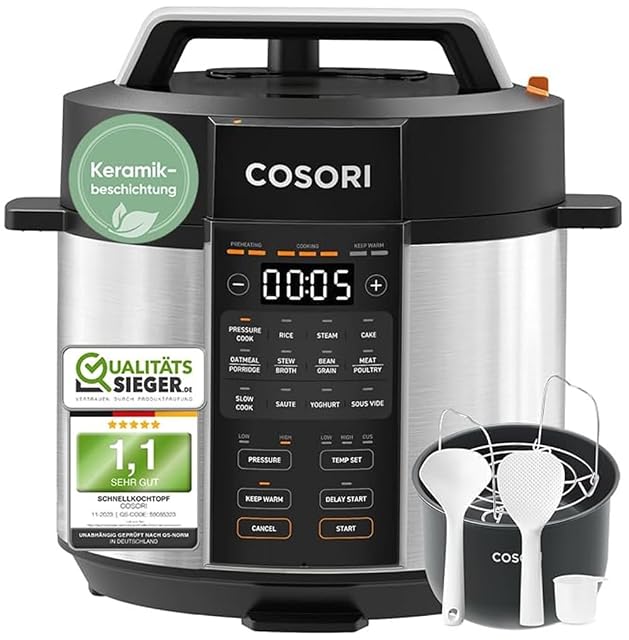
Three say “ceramic” with no chemistry: the Sweetcrispy at $49.91, the Cosori at $80.99, the PowerXL at $95.99. One says only “Nonstick Pot”: the COMFEE’ at $68.99.
What stainless buys: nothing to lose.
A ceramic sol-gel coating gets less non-stick with use. That is its known failure mode — and it is why four pages on this shelf sell the chemistry rather than the durability. Stainless does not change.
It can be scrubbed with a scourer, soaked overnight, and run through a dishwasher indefinitely. And the Ninja PossibleCooker PLUS at $129.99 is honest about the alternative: “Utensil & glass lid are dishwasher safe. Hand-washing pot recommended to extend its life.”
What stainless gives up is release. Food sticks to steel, so a sauté in this needs fat where a sauté in a coated pot does not.
And a stuck fond on stainless is a feature rather than a fault. It is what you deglaze — the browned layer that dissolves into a splash of wine or stock — and it is the flavor a non-stick pot never develops. Which matters on a machine whose second function is sauté.
Seven in the title, seven in the list
Bullet one names them: “Pressure cook, slow cook, sauté, steam, cook rice, make yogurt, or keep your meals warm.”
Seven claimed, seven named. Two pages on this shelf are self-consistent and this is one.
The other is the PowerXL at $95.99, which publishes no “in-1” count at all and names nine presets exactly.
The rest:
COMFEE’, $68.99 — three incompatible numbers on one page: a title of “12-in-1”, a bullet headed “9 IN 1” naming nine, and a bullet headed “12PRESETS” whose text says “14”
Cosori, $80.99 — “9-in-1”, and a bullet listing thirteen functions
BELLA, $79.99 — “10-in-1”, “Replace Ten Bulky Kitchen Appliances”, four named, “eight presets”
Sweetcrispy, $49.91 — “16-in-1”, four appliances and twelve presets
Ninja PossibleCooker PLUS, $129.99 — “6-in-1”, six functions named twice, “REPLACES 12 COOKING TOOLS”
Ninja PRO Plus, $139.99 — “9-in-1”, nine named, “REPLACES 16”
Ninja HyperHeat, $139.99 — “9-in-1”, seven named plus “and more”
Presto, $88.76 — no count at all, just a list of verbs
Count the listed functions, not the marketing number. A preset is a button; an “in-1” is a claim about appliances you might otherwise own, and every maker here counts it differently.
And one of the seven here tells you most about the machine: yogurt.
Yogurt needs a long hold at about 43 °C — far below anything else a pressure cooker does. A machine with a yogurt program has fine low-temperature control and one without may not — and four other machines on this shelf offer it: the Sweetcrispy at $49.91, the COMFEE’ at $68.99, the Cosori at $80.99 (as “Ferment”) and the three Ninja HyperHeat machines.
Four quarts, and the fill line that makes it smaller
“The 4-quart capacity is perfect for up to 4 servings, ideal for students, singles, and small families” · “offering the same cooking surface as an 8-inch pan”
It is the smallest pot on this shelf by two quarts, and the only machine here sold for one or two people.
The shelf by capacity:
4 qt — this
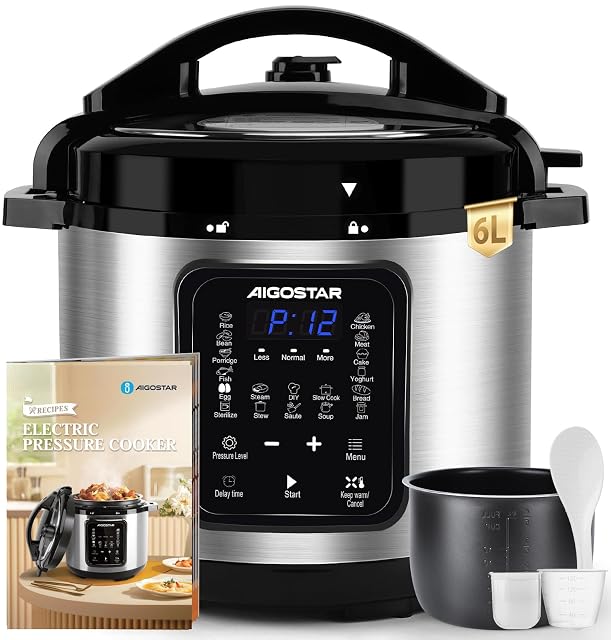
6 qt — the Sweetcrispy at $49.91 (“households of 3 to 5”, “whole chicken”), the COMFEE’ at $68.99, the Cosori at $80.99
6.5 qt — the three Ninja HyperHeat machines (“a 4-lb chicken or 5-lb roast, feeding 8–10 people”, on a “9.5” diameter” surface)
7 or 8.5 qt — the three BELLA machines, which contradict themselves: “7qt” in the title and “8.5-quart” in bullet two
7.5 qt — the PowerXL at $95.99 (“two whole chickens or 6LBS of pork”)
8.5 qt — the Ninja PossibleCooker PLUS at $129.99 (“chili for up to 20 people”, “9 lbs of spaghetti”) and the PRO Plus at $139.99 (“10 lbs of spaghetti”)
10 qt — the Presto at $88.76
And there is a limit on every pressure cooker here that no page on this shelf states.
A pressure cooker is never filled to the brim. Typically no more than two thirds for solids, and half for anything that foams — beans, rice, oats, pasta, split peas — because foam carried into the vent is how a pressure cooker blocks, and a blocked vent is the failure the safety features exist to catch.
So four quarts is about a 2.7-quart cooking volume for most things and two quarts for grains.
Which makes “up to 4 servings” the honest figure, and the eight-inch-pan comparison the right one. An 8-inch pan is a one-or-two-person pan, and that is what this machine is.
It is also the figure that frames the footprint: 318 × 351 × 256 mm. Compare the Ninja PossibleCooker PLUS at 457 × 321 × 269 mm and the Ninja PRO Plus at 415 × 367 × 281 mm — both 8.5 quarts, and both substantially wider. The Presto at $88.76 is 406 × 311 × 210 mm for ten quarts, which is the opposite extreme: a wide shallow kettle rather than a tall narrow vessel.
And at 4944 grams this is heavier than two larger machines here — the three BELLA at 4196–4200 g (8.5 qt) and the Presto at 3139 g (10 qt). A pressure cooker is a vessel with a locking lid, a gasket, a valve and a sensor, and that is where the weight goes.
Anti-spin, which nothing else here publishes
“Anti-spin design ensures the pot stays steady for effortless stirring and sautéing”
It sounds like a small thing and it is the most practical detail on the page.
An inner pot sits loose in the body of an electric cooker, so the moment you stir or scrape, the pot turns with the spoon. On a sauté, where you are pushing onions against the side, that is the difference between cooking and chasing a pot round a countertop — and with a hot machine it is also a safety point.
No other page on this shelf mentions it, and every machine here with a removable pot has the same problem.
What the others publish instead is a different fix: a pot you take out entirely.
Ninja HyperHeat, three machines — a “removable SimpliServe pot” that “goes from cooker to table”
Ninja PossibleCooker PLUS and PRO Plus — a removable pot “oven-safe up to 500°F”, so a braise can be finished under an oven’s top heat
Presto, $88.76 — the whole kettle, “fully immersible with heat control removed”
And the progress indicator in bullet four is the other interface detail. “Progress indicator lets you monitor your cooking status with ease.”
On a pressure cooker that is worth more than on anything else here, because a pressure cooker spends most of its cycle doing something you cannot see: building pressure, holding it, releasing it. A machine that shows which phase it is in is a machine you do not stand over.
Two other pages address the same blindness differently. The Sweetcrispy at $49.91 has “a clear lid reminder on the display” — and the Cosori at $80.99 solves it mechanically with “align the orange dot on the lid with the orange dot on the pressure cooker base”.
Eight hundred watts, and the only electrical listing on this shelf
“800 watts, 120 V 60 Hz, UL & ULC Listed. Includes a versatile stainless steel steam rack”
It is the only page among fourteen to publish a voltage, a frequency or a safety listing.
The wattages here:
1400 W — the Ninja PRO Plus at $139.99: “MORE POWERFUL SEARING*… 1400-watt power”
1200 W — the three BELLA machines and the three Ninja HyperHeat machines
800 W — this
None — eight machines: the Sweetcrispy at $49.91, the COMFEE’ at $68.99, the Cosori at $80.99, the Presto at $88.76, the PowerXL at $95.99 and the Ninja PossibleCooker PLUS at $129.99
On a pressure cooker, wattage is time to pressure. The advertised cooking time excludes the ten to fifteen minutes the machine spends heating up — and Ninja’s HyperHeat pages say so with an asterisk: white rice “in as little as 8 minutes*”, where the asterisk reads “Excludes time to build and release pressure.”
Eight hundred watts is the lowest figure on this shelf and it is not mean for the pot. 800 watts on 4 quarts is about 200 watts a quart. 1200 watts on a 6.5-quart Ninja HyperHeat is about 185. 1200 watts on an 8.5-quart BELLA is about 141.
So per quart this is the best-powered machine on the shelf — and it is the only page here that lets you do that arithmetic at all, because the other two pot sizes with a published wattage are larger.
At 120 volts, 800 watts is 6.7 amperes — comfortably inside a 15-amp circuit, with room for a kettle alongside. 1400 W is 11.7 A, which is most of one.
And “UL & ULC Listed” is the claim nothing else here makes. UL is the United States safety certification and ULC the Canadian one — a listing means the appliance has been tested against a published standard by an independent laboratory, which on a pressurized vessel with a heating element in it is the one piece of third-party assurance on this shelf.
The steam rack is the included accessory. A rack lifts food off the base so it steams rather than boils, and it is what lets you cook two things at once with one above the liquid. The COMFEE’ at $68.99 includes one among six itemized components; the Presto at $88.76 has a basket instead, which “hooks onto rim of multi-cooker for draining”.
Over ten safety features, and an auto-sealing lid
“Features over 10 proven safety features, including overheat protection and an auto-sealing locking lid”
The counts on this shelf:
12 — the Cosori at $80.99, which also publishes the best geometry here: “The Seal/Vent button away from the steam release valve, and the 30° backward-angled steam release design”, plus a “double-layer anti-scalding lid”
Over 10 — this
10 — the COMFEE’ at $68.99: “overheat protection, auto pressure release and lid-safety lock system”
A multi-level system, uncounted — the Sweetcrispy at $49.91, the only machine here with dry-boil protection and a lid reminder on the display
None — the eight non-pressure machines, reasonably: without pressure there is no vessel to fail
What the two named here do.
Overheat protection cuts the element if the base gets too hot — which is what saves a pot boiled dry. And the Sweetcrispy’s dry-boil protection is the specific version of that: a pressure cooker needs liquid, because pressure comes from water turning to steam, and a dry pot reaches element temperature rather than boiling point.
An auto-sealing locking lid means the lid seals itself as pressure builds and cannot be opened while the vessel is pressurized. That mechanism is what makes a modern electric pressure cooker a different object from a stovetop one.
And the one safety habit no page on this shelf publishes concerns the sealing ring.
A silicone ring in the lid is the entire pressure seal. It compresses against the pot rim and holds the vessel shut — and when it hardens, cracks or takes a set, the cooker stops reaching pressure and vents at the rim instead. It also absorbs smell: a ring that has made curry will flavor a rice pudding.
One machine on this shelf mentions it at all — the Sweetcrispy at $49.91, which states that it is dishwasher safe. No page here publishes a replacement interval, a part number or a price, and no page publishes a warranty.
Store the lid upside down on the pot rather than closed, so the ring is not left compressed.
What is not published
No pressure figure. No machine on this shelf publishes its operating pressure or its high and low settings in psi or kPa — which is the one specification that defines a pressure cooker, and the one that decides whether a recipe written for another machine will work in it.
No temperature range. Two machines on this shelf publish an oven rating — the Ninja PossibleCooker PLUS at $129.99 and PRO Plus at $139.99, both “oven-safe up to 500°F” — and the three BELLA machines publish a cooking temperature of “up to 400°F”. On a machine whose second function is sauté, the sauté temperature is the figure to want — browning does not begin below about 140 °C.
No delay timer, where the Sweetcrispy at $49.91 and the COMFEE’ at $68.99 both publish 24 hours. With one caveat neither of them gives: food sitting at room temperature in a sealed pot for hours before cooking is a food-safety question, so a delay start is for oats and grains rather than raw chicken.
No sous vide, which six machines on this shelf claim: the Cosori at $80.99, the Ninja PossibleCooker PLUS at $129.99, the PRO Plus at $139.99 and the three Ninja HyperHeat machines. None publishes a temperature tolerance — and sous vide means holding water within a degree for hours, which is a harder specification than any of those pages states. Its absence here is arguably the more honest position.
No sealing ring, as above.
No fill-line guidance, as above — and on a 4-quart pot it matters more than on an 8.5-quart one.
No warranty, which no item on this shelf publishes.
No country of manufacture, which no item on this shelf publishes either.
Availability
Read on the day this page was built: $90 at the American Amazon shop.
Read from Keepa on the day this page was last revised; stock and price both move without notice.
Prices quoted in this text were read on 2026-10-05. The live price is at the top of the page.