What the maker puts in writing
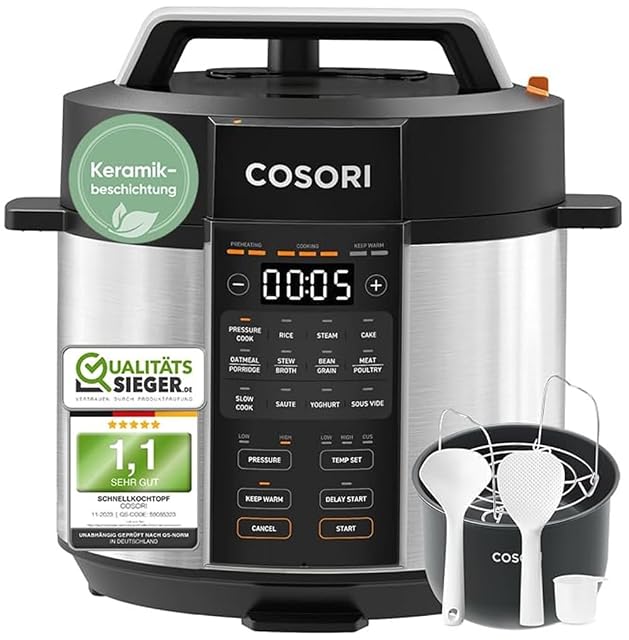
- “9 Machines in 1: Pressure Cook, Rice, Steam, Sterilize, Oatmeal/Porridge, Stew/Broth, Bean/Grain, Meat/Poultry, Slow Cook, Sauté, Ferment, Sous Vide, Keep Warm”
- “Safer Venting Design: The Seal/Vent button away from the steam release value, and the 30° backward-angled steam release design, make a safer and easier venting”
- “Easy To Clean: Stainless steel, fingerprint-resistant housing, the 0.5-inch widened pot gap, and the dishwasher-safe lid, ceramic coating inner pot, and accessories make cleanup a breeze”
- “Easy Lid Locking: To close and secure the lid, align the orange dot on the lid with the orange dot on the pressure cooker base and twist clockwise”
- “12 Safety Features: The pressure cooker is designed with a double-layer anti-scalding lid and overheat protection to keep cooking safe”
- From the name: “6QT”, “Ceramic Coating Pot”
- Reference CMC-CO601-SUS · Catalog: 5398 g (190.4 oz)
The only page here that tells you where the steam goes
“The Seal/Vent button away from the steam release value, and the 30° backward-angled steam release design, make a safer and easier venting.”
The valve is where people get burned, and this is the only page on this shelf to describe its geometry.
What happens when a pressure cooker vents. A six-quart cooker at pressure holds steam at about 120 °C, and releasing it sends a jet upward from the lid.
Steam carries far more heat than air at the same temperature, because condensing on skin releases its latent heat all at once. Which is why a steam scald is worse than a hot-air burn.
Two things make the moment dangerous.
Reaching across the jet to turn the valve. On most machines the knob and the vent are the same assembly, so your hand goes where the steam is.
And a jet that goes straight up into a wall cabinet, where it rebounds down onto you.
This design answers both. The button is somewhere else, so your hand is never in the path. And the jet is angled 30 degrees backwards, away from where you stand.
How the rest of the shelf covers safety.
COMFEE’, $68.99 — “10 safety features”, three named: “overheat protection, auto pressure release and lid-safety lock system”
Instant Pot Rio Mini, $89.99 — “over 10 proven safety features, including overheat protection and an auto-sealing locking lid”
Sweetcrispy, $49.91 — a multi-level system with two items nothing else here publishes: dry-boil protection, and a lid reminder on the display
this — 12, the highest count on this shelf, plus a “double-layer anti-scalding lid”
The eight non-pressure machines — none, reasonably: without pressure there is no vessel to fail
Twelve is the highest count, and the count is the less interesting half of this page. The geometry is the part worth paying for.
And bullet four is the other piece of the same thinking. “To close and secure the lid, align the orange dot on the lid with the orange dot on the pressure cooker base and twist clockwise.”
It is the only page on this shelf that explains how to shut the machine — and a lid that is not fully seated is a lid that vents at the rim and never reaches pressure. A colored alignment mark is the cheapest possible way to get it right in the dark.
The Sweetcrispy at $49.91 solves the same problem electronically, with “a clear lid reminder on the display”.
Nine in the title, thirteen in the list
The title says “9-in-1”. Bullet one lists thirteen: Pressure Cook, Rice, Steam, Sterilize, Oatmeal/Porridge, Stew/Broth, Bean/Grain, Meat/Poultry, Slow Cook, Sauté, Ferment, Sous Vide, Keep Warm.
Which is close to universal on this shelf.
COMFEE’, $68.99 — three incompatible numbers on one page: a title of “12-in-1”, a bullet headed “9 IN 1” naming nine, and a bullet headed “12PRESETS” whose text says “14”
BELLA, $79.99 — “10-in-1”, “Replace Ten Bulky Kitchen Appliances”, four named, “eight presets”
Sweetcrispy, $49.91 — “16-in-1”, four appliances and twelve presets
Ninja PossibleCooker PLUS, $129.99 — “6-in-1” and “REPLACES 12 COOKING TOOLS”
Ninja PRO Plus, $139.99 — “9-in-1”, nine named, “REPLACES 16”
Ninja HyperHeat, $139.99 — “9-in-1”, seven named plus “and more”
Presto, $88.76 — no count at all, just a list
Two pages here are self-consistent: the Instant Pot Rio Mini at $89.99 (“7-in-1”, seven named) and the PowerXL at $95.99 (no “in-1” count, nine presets named exactly).
Four items in this list are worth singling out.
Sterilize appears on no other page on this shelf. And a pressure cooker genuinely does it: steam at 120 °C is the sterilizing condition, which is why autoclaves work the same way — so this is a real function rather than a label on a timer.
Ferment — the same job as yogurt, and the hardest thing a pressure cooker’s thermostat does: a long hold at about 43 °C, far below anything else on the machine.
Keep Warm — on seven machines here.
Sous Vide — the claim to be skeptical about, below.
Count the listed functions, not the marketing number. Thirteen named is thirteen buttons; “9-in-1” is a claim about appliances you might otherwise own, and every maker here counts it differently.
Sous vide, and what no page on this shelf publishes
At least six of the eighteen machines here claim it: this, the Ninja PossibleCooker PLUS at $129.99, the Ninja PRO Plus at $139.99 and the three Ninja HyperHeat machines.
Not one publishes a temperature tolerance.
Why that is the specification that matters. Sous vide is not a temperature, it is a held temperature.
An egg cooked at 63 °C and an egg cooked at 65 °C are different foods. A steak held at 54.5 °C for two hours is medium rare; the same steak at 58 °C is medium. A dedicated immersion circulator holds within about 0.1 °C and stirs the water, and the stirring is half the point.
What a multi-cooker has instead. A thermostat sensing the base of the pot rather than the water — and a heating element at the bottom of a still bath, which stratifies. The water at the base is hotter than the water at the top, and nothing moves it.
So the honest position: a sous-vide preset on any of these six machines is a low-temperature water bath rather than a circulator. Fine for a confit, a long egg or a reheat. Less reliable for a steak you want at exactly one doneness.
And this page carries an adjacent fact that is in its favor. The same machine lists Ferment, which needs a long hold at about 43 °C — and a thermostat that can hold 43 °C for yogurt is one with fine control at the bottom of its range.
What to do: use it, and check it with a thermometer the first time. At least nine of the eighteen machines on this shelf would need the same check, and none of them tells you the answer.
A stainless housing, a dishwasher-safe ceramic pot, and half an inch of gap
“Stainless steel, fingerprint-resistant housing, the 0.5-inch widened pot gap, and the dishwasher-safe lid, ceramic coating inner pot, and accessories make cleanup a breeze”
Three cleaning details, and two of them are rare on this shelf.
The pot gap. The space between the inner pot and the body is where a pressure cooker collects everything that boils over — and on most machines it is a half-inch crevice you cannot reach with a cloth. Widening it to half an inch is a straightforward answer, and no other page on this shelf mentions the gap at all.
And the pot itself stated dishwasher safe. Most of this shelf does not go that far.
Instant Pot, $89.99 — “Dishwasher-safe lid and cooking stainless steel pot”
Ninja PRO Plus, $139.99 — “Inner pot, lid, and spoon are all dishwasher safe”
PowerXL, $95.99 — “Pot, Lid, and Paddle go straight into the dishwasher”
this — lid, ceramic pot and accessories
Sweetcrispy, $49.91 — “The lid and sealing ring are dishwasher safe” — the pot is not named
Ninja PossibleCooker PLUS, $129.99 — the most honest split on the shelf: “Utensil & glass lid are dishwasher safe. Hand-washing pot recommended to extend its life.”
COMFEE’ $68.99, the three BELLA machines, the Presto $88.76 and the three Ninja HyperHeat machines — no dishwasher statement at all
That Ninja caveat is the one to keep in mind even here. A dishwasher cycle is hot, alkaline and abrasive, and a ceramic coating is what it wears — so the claim means the pot will survive the machine, not that it will last as long that way.
What the page does not publish is the coating chemistry. “Ceramic coating” and nothing more.
Four items on this shelf publish a chemistry claim. BELLA at $79.99 footnotes it — “ceramic coating materials made without PFAS, PTFE, PFOA, lead or cadmium”, the only footnote here. Presto at $88.76 — “PFAS-free ceramic nonstick finish, inside and out”. Ninja PRO Plus at $139.99 — “MADE 100% PFAS FREE… no PFAS, PTFEs, or PFOAs”. Ninja HyperHeat — “made 100% PFAS-free”. And the weak version, from the same maker as the two strong ones: the Ninja PossibleCooker PLUS at $129.99 — “Free of PFOA, cadmium, and lead”, which says nothing about PFAS or PTFE.
Three pages say “ceramic” with no chemistry: this, the Sweetcrispy at $49.91 and the PowerXL at $95.99.
And the fingerprint-resistant stainless housing is the other half of the cleaning claim — and the detail that distinguishes this machine visually from the plastic bodies elsewhere on this shelf. The OXO-style point applies: stainless does not discolour next to steam, and painted plastic eventually does.
Six quarts, and the fill line nobody mentions
Six quarts is the commonest capacity here — this, the Sweetcrispy at $49.91 and the COMFEE’ at $68.99.
The full range: 4 qt — the Instant Pot Rio Mini at $89.99 · 6 qt — three machines · 6.5 qt — the three Ninja HyperHeat machines · 7 or 8.5 qt — the three BELLA machines, which contradict themselves: “7qt” in the title and “8.5-quart” in bullet two · 7.5 qt — the PowerXL at $95.99 · 8.5 qt — the two Ninja PossibleCookers · 10 qt — the Presto at $88.76, the largest here.
And the limit no page on this shelf states: a pressure cooker is never filled to the brim.
Typically no more than two thirds for solids, and half for anything that foams — beans, rice, oats, pasta, split peas. Foam carried into the vent is how a pressure cooker blocks, and a blocked vent is the one failure the twelve safety features exist to catch.
So a six-quart pressure cooker is a four-quart cooking volume for most things and a three-quart one for grains.
Which is worth setting against the three BELLA machines on this shelf at $79.99 and $93.95. They are not pressure cookers, so 8.5 quarts of slow-cooking space really is 8.5 quarts — and that is a genuine difference in usable volume at a similar price.
On weight, this and the Sweetcrispy are identical at 5398 g. The shelf runs from the Presto at 3139 g — the lightest machine here with the largest pot, because it is a thin kettle with a plug-in control rather than a pressure vessel — to the three Ninja HyperHeat machines at 7199 g, which is 2.3 times the Presto for two thirds of the capacity.
What is not published
No wattage. On a pressure cooker this is time to pressure. The advertised cooking time excludes the ten to fifteen minutes the machine spends heating up — and Ninja’s HyperHeat pages make exactly that point with an asterisk: white rice “in as little as 8 minutes*”, where the asterisk reads “Excludes time to build and release pressure.”
At least six of the eighteen machines here publish a wattage: 1400 W on the Ninja PRO Plus · 1200 W on the three BELLA and three Ninja HyperHeat machines · 800 W on the Instant Pot, which is also the only item on this shelf to publish “120 V 60 Hz, UL & ULC Listed”.
No pressure figure. No machine on this shelf publishes its operating pressure or its high and low settings in psi or kPa — which is the one specification that defines a pressure cooker, and the one that decides whether a recipe written for another machine will work.
No coating chemistry, as above.
No dimensions. Six machines on this shelf publish a footprint; this does not.
No cooking surface diameter, where the Ninja HyperHeat machines publish “9.5” diameter” and the Instant Pot describes “the same cooking surface as an 8-inch pan”.
No delay timer, where two machines publish 24 hours: the Sweetcrispy at $49.91 and the COMFEE’ at $68.99.
No accessories itemized. “Accessories” appears in the cleaning bullet and nothing names them — where the COMFEE’ at $68.99 lists “6 helpful components: Spoon, Ladel, Condensation Cup, Measuring Cup, Steam Rack, Power cord” and the Instant Pot includes a “stainless steel steam rack”.
No sealing ring. A silicone ring in the lid is the entire pressure seal, and it is the consumable on every pressure cooker here. It hardens, takes a set and absorbs smell — a ring that has made curry will flavor a rice pudding. One machine on this shelf mentions it at all: the Sweetcrispy at $49.91, which states that it is dishwasher safe. No page here publishes a replacement interval, a part number or a price. Store the lid upside down rather than closed, so the ring is not left compressed.
No sous-vide tolerance, as above.
No warranty, which no item on this shelf publishes.
No country of manufacture, which no item on this shelf publishes either.
Availability
Read on the day this page was built: $81 at the American Amazon shop.
Read from Keepa on the day this page was last revised; stock and price both move without notice.
Prices quoted in this text were read on 2026-10-05. The live price is at the top of the page.